
How it works
Six steps, from the test to your application.
Screenshots from the demo. The universities shown are fictional.
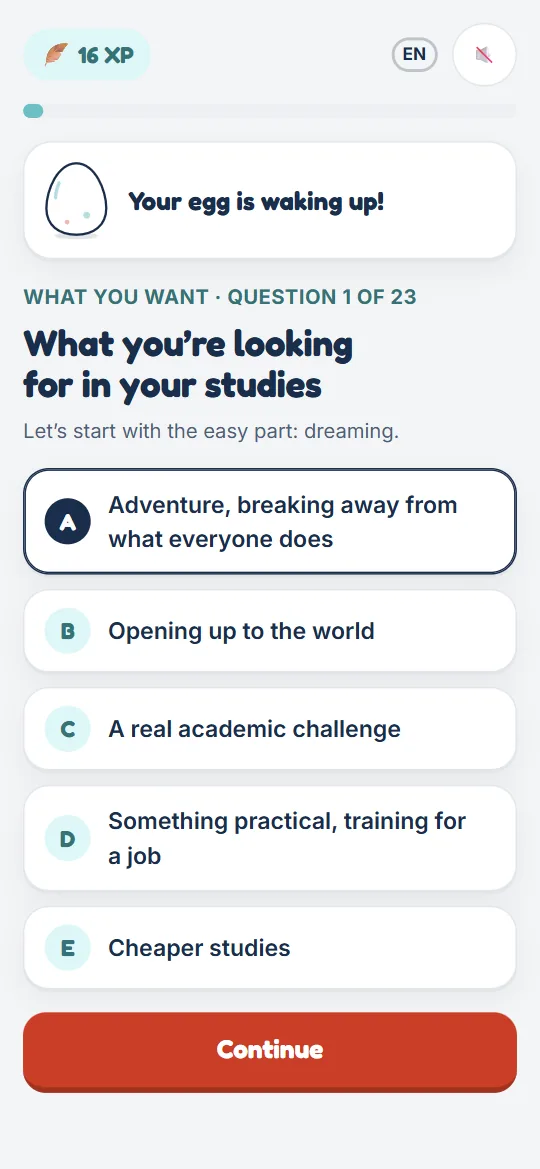
Step 01
The test
23 questions, 5 min: your profile, what you want, your budget.
- The teaching languages you accept.
- The countries and fields you rule out.
- Your budget: above it, the university drops off the list.
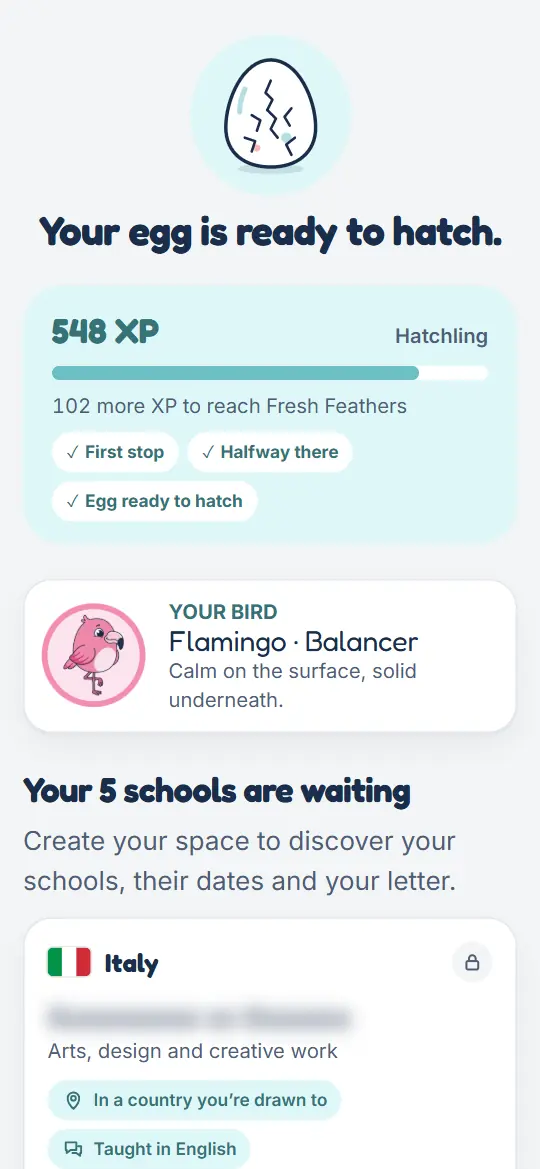
Step 02
Your universities
Ranked by your answers. Each university says why it is there.
- The ranking cannot be bought.
- No AI in the ranking: same answers, same universities.
- An incomplete university page is never suggested.
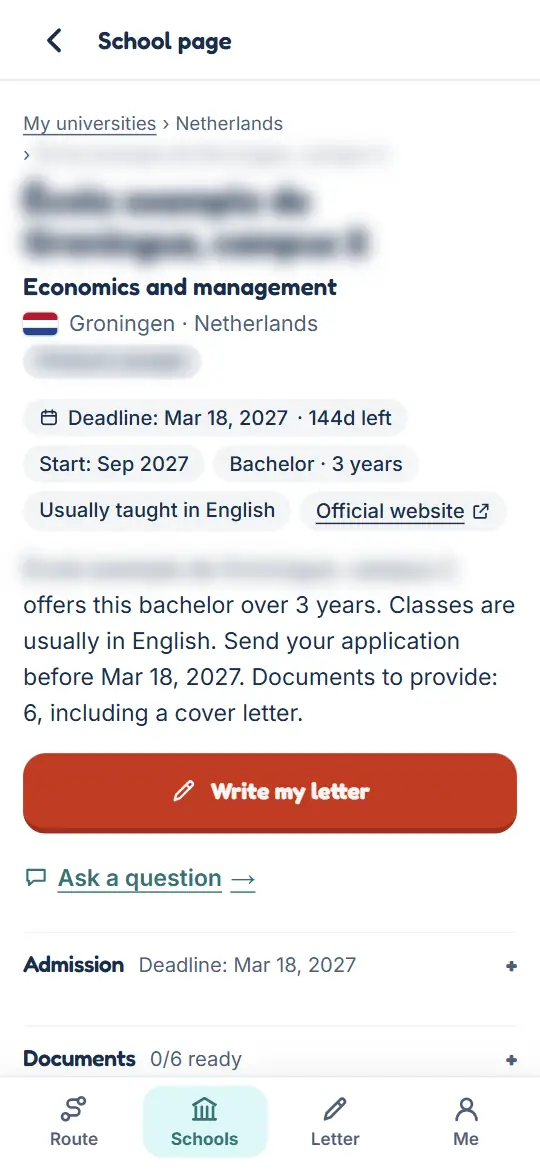
Step 03
The university page
Dates first. Then the teaching language, the length, the documents to send.
- The deadline and the start date, first.
- Fees and admission, read on the official website.
- The source and the date it was checked, on every page.
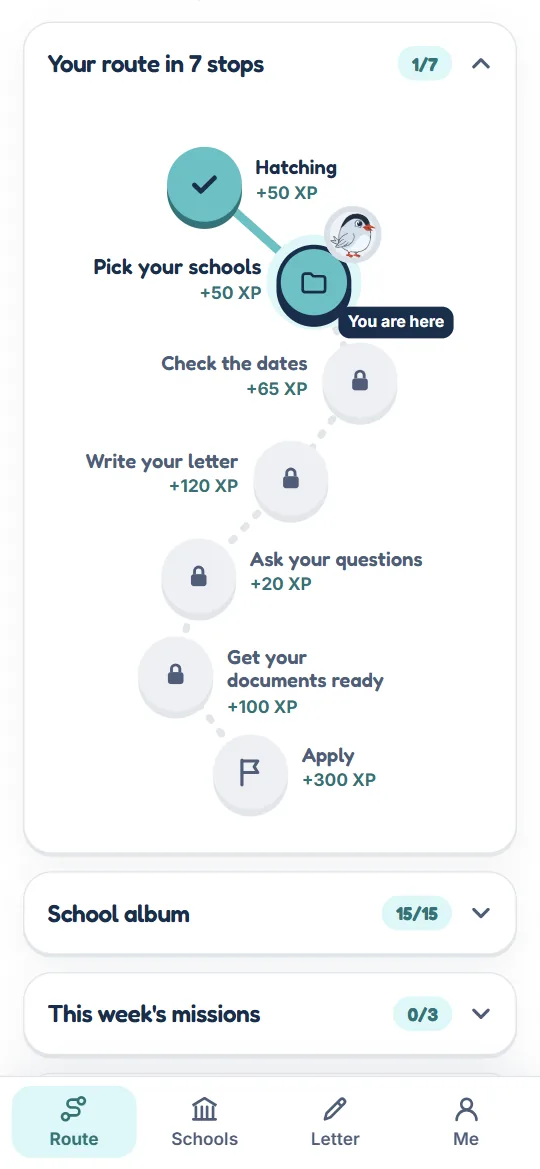
Step 04
Your route
Each day, just one thing to do for your application.
- Today's step, and nothing else.
- Your applications, all in one place.
Step 05
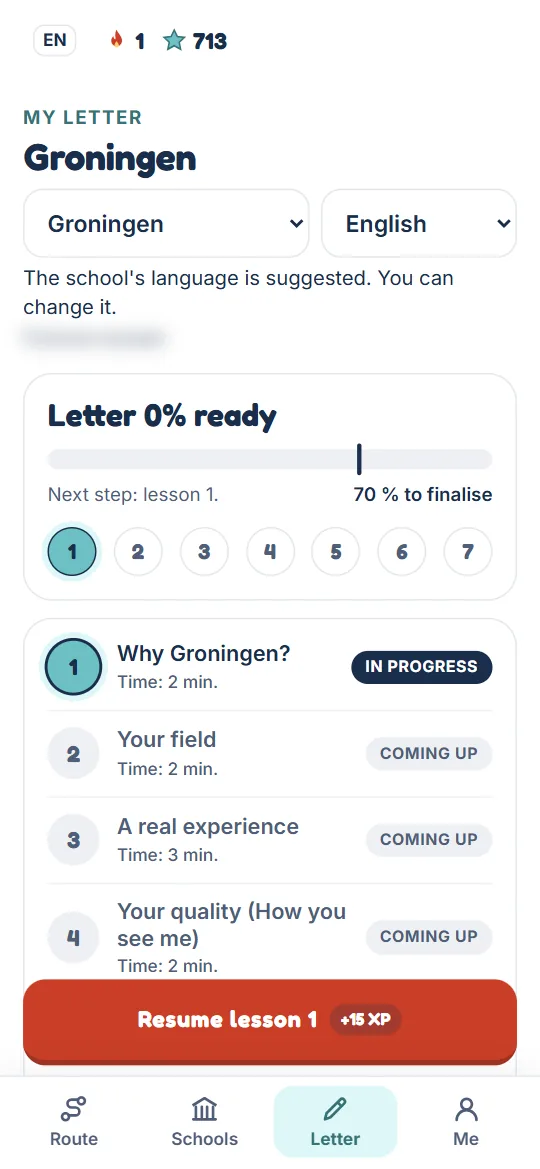
Write your letter
Lesson by lesson, in your own words. One letter per university.
- Your progress, lesson after lesson.
- The text stays yours.
Step 06
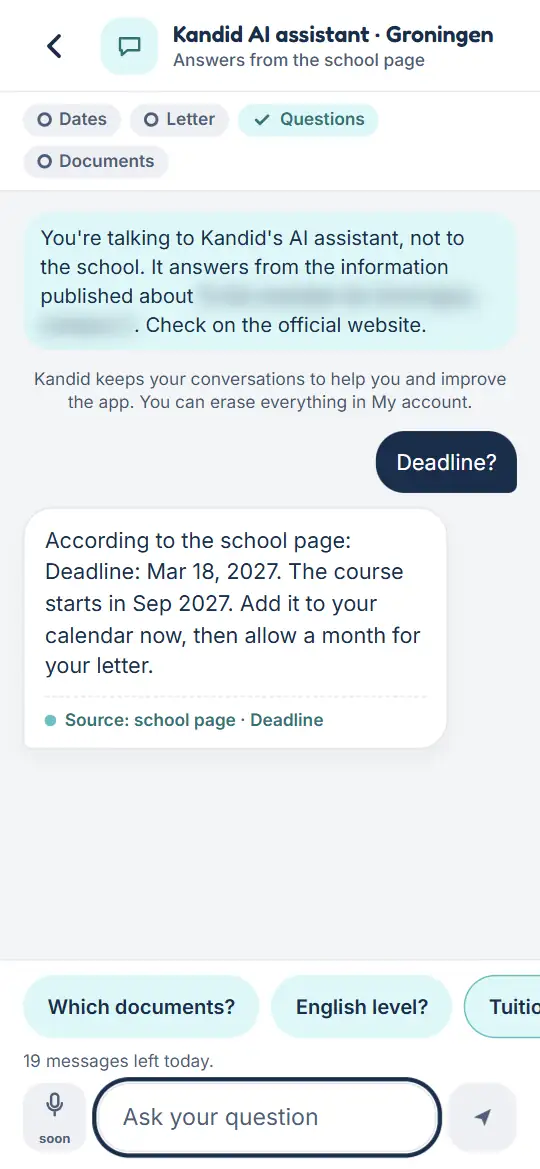
Ask your questions
Admission, documents, language level. The answers cite the university page.
- Answers generated from the university's official data.
- Admission is decided by the university.
Then you apply through your portal or on the university's official website.
A one-of-a-kind database in Europe
- 70,000+programmes listed
- Over 3,000application deadlines listed
- 44countries listed
Where the data comes from
- Bachelor's programmes come from the countries' official registers: ministries, the bodies that check degrees.
- Universities are cross-checked against the European register ETER, which lists higher education institutions.
- Dates, fees, language and admission are read on the university's official website.
- Each university page shows its source and the date it was checked.
- An incomplete university page is never suggested. No commercial comparison site is used.
What the ranking compares
Your profile has 11 criteria. The ranking compares 10 of them with each bachelor's programme.
- International outlook
- Academic ambition
- Appetite for risk · For your bird, not for the ranking.
- Numbers or words
- Theory or practice
- Guidance or independence
- Big or small city
- Social life
- Cost of studies
- Broad or specialised course
- Teaching languages
Before comparing, Kandid removes what you rule out: budget exceeded, language not ticked, field or country excluded.
Neutrality
- The ranking cannot be bought.
- The ranking never uses data that a university can change.
- No AI ranks your universities: same answers, same universities.
- When your top 5 has no school from an international ranking (QS, THE, ARWU, CWUR), we replace the 5th suggestion with the best ranked school that fits your profile.
- An automated check in the code verifies these rules.
Frequently asked questions
How do I get into the test?
With an access code. No code? Leave your email on the test page and we'll send you yours.
Does it guarantee a place?
No. Kandid gives you universities, not an admission. The university decides.
Can a university pay to be ranked higher?
No. The ranking cannot be bought, and it uses no data that a university can change.
Do I need to be bilingual?
No. Each university sets its own language level, and the test asks which languages you accept.
Will my degree be recognised?
In Europe, higher education follows a shared framework: bachelor, master, doctorate. Official recognition is a separate step.